

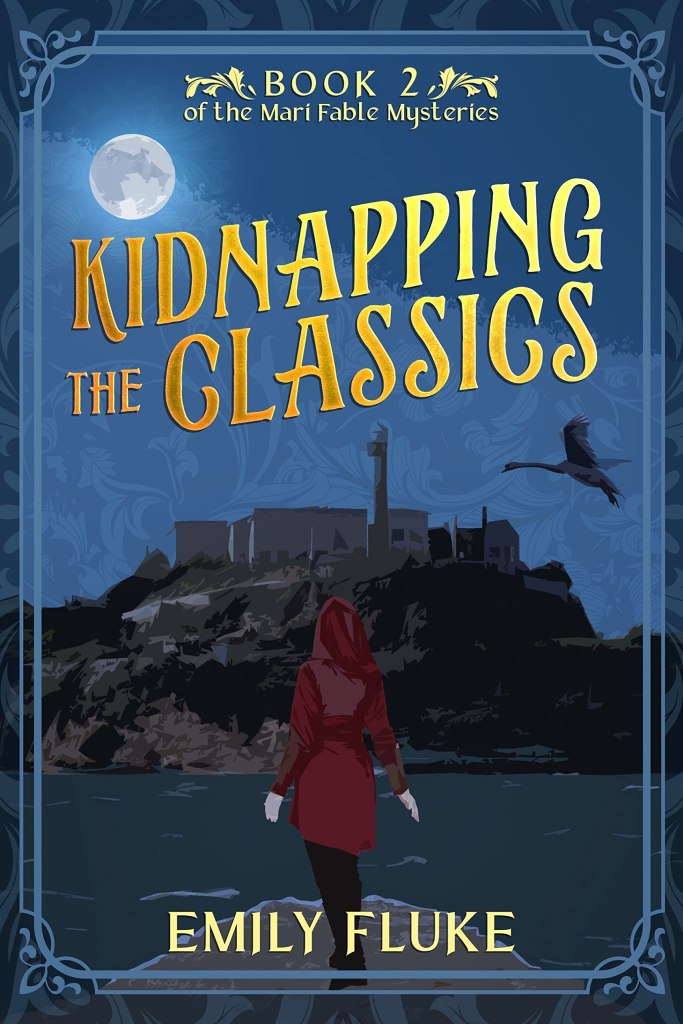
Kidnapping the Classics by Emily Fluke, narrated by Suzanne T. Fortin, offers a fresh and imaginative twist on fairy-tale fantasy. Instead of stepping into a single familiar story, Mari inherits the role of Keeper of Stories—the guardian responsible for every classic fairy tale that slips into existence in the real world, right in the heart of the San Francisco Bay.
Uncertain about what qualifies as “classic” or when these tales will emerge in the mortal realm, Mari does her best to balance her supernatural calling with the very human demands of motherhood and journalism. Tracking down wandering villains is hardly something she has time for, yet destiny refuses to let her ignore it. When Mari’s mother escapes to Cygnus Island in hopes of finally breaking free from an estranged marriage, everything spirals. Mari gets a call that forces her hand: she must embrace her Keeper role, uncover the fairy tale at play, and find her mother—bringing her back to the island she’d hoped never to see again.
about the characters
Mari, our main character, is refreshingly direct and open about her emotions, especially as she grapples with the unexpected weight of becoming the new Keeper of Stories. She’s juggling more than any one person should—magical responsibility, investigative journalism, and raising a toddler—yet her love for her family always anchors her. Her husband, though not present for most of the story, is written as wonderfully supportive and deeply caring. He uplifts her in moments of doubt and gives her space to embrace her Keeper role without making her feel guilty for the chaos that comes with it. Mari is both headstrong and deeply afraid of what her future now holds, and that duality makes her compelling. Her mother, meanwhile, constantly reassures her about things Mari can’t quite shake—like her daughter’s developmental progress and the ever-looming uncertainties of parenthood. Their relationship adds emotional texture, especially as Mari confronts how fairy tales intertwine with her family’s past.
Scarlet, a former Keeper of Stories herself, is an intriguing presence. Once immortal and confident in her role, she is now human and visibly adrift, trying to navigate the mortal world with only television as her guide. Though she’s introduced simply as Wendy’s babysitter when the group travels to Cygnus Island, her perspective is invaluable. She understands the mechanics of the fairy-tale realm better than anyone, even if she no longer knows where she fits within it. Her character hints at a much larger arc in the previous installment, but here she brings both vulnerability and wisdom to the narrative.
Mari’s father is another emotional anchor in the story, though his presence is far more complicated. Having grown up almost entirely under her mother’s care, Mari never truly knew him, and the distance between them sits heavily on her shoulders. When she arrives on Cygnus Island, she’s forced to reconcile the childhood absence that shaped her with the man she finds in the kingdom—a man more pitiful than powerful, weighed down by his own regrets and entanglements. Their strained reunion adds a layer of grief and tenderness to the narrative, reminding Mari that some wounds can’t be mended simply by proximity.
The Queen, in stark contrast, exudes a cold and calculated demeanor from the moment she steps into the story. She rules with a detached precision that lacks genuine empathy for her people, and her presence casts a sharp chill across the kingdom. Something about her, and the court as a whole, feels fundamentally off, a sense heightened by the vivid story auras that shimmer around each person. These glowing markers of their ties to particular tales only deepen the unsettling feeling that the Queen’s motives run far deeper than what she presents.
Johnson, her father’s loyal henchman, reinforces that sense of unease. From the start, he carries an air of ulterior motive, acting more like a watchdog than a protector. His allegiance feels transactional, rooted in something obscure and self-serving. As Mari pieces together the overlapping stories at play, Johnson becomes a reminder that not everyone in Cygnus Island’s kingdom is guided by honor—or even honesty.
standout moments
One of the most memorable moments in Kidnapping the Classics is the murder of a servant girl from the kingdom. Mari and Scarlet are in the middle of a tense conversation with the Queen when several men rush in to deliver the news. The Queen’s reaction is instantly unsettling—far too composed, almost indifferent, especially for someone who is supposed to be the heart of her community. Her expression alone raises suspicion, but Mari’s instincts fire on all cylinders. Even while terrified for her missing mother, she pivots straight into investigative mode.
This moment also cleverly plays with reader expectations. The chapter title, paired with the nature of the murder, initially evokes the Queen of Hearts, leading you to think you know which fairy tale is unfolding. But Fluke uses that assumption to her advantage, subtly redirecting the narrative and revealing a storyline that becomes much more intricate than the obvious choice.
Another standout is the incorporation of Frankenstein’s monster. This tragic figure has always been one of the most haunting literary creations, and Fluke captures that same emotional weight here. The monster’s inherent misery, the inevitability of his downfall, and the sorrow that follows him into every adaptation all ripple into this tale. His presence adds a melancholy depth to the novel, echoing themes of creation, consequence, and the pain of being misunderstood. For readers who appreciate the many interpretations of Frankenstein across literature and film, as I do, this moment feels especially powerful and kept me listening to see how his story influences Mari’s world.
personal reflection
The concept behind Kidnapping the Classics is undeniably inventive and wonderfully creative, offering a fresh interpretation of classic fairy tales that fits its fantasy audience exceptionally well. Fluke’s retellings feel credible, honoring the original works penned by various authors while adding new emotional depth through relationships and the wide range of feelings Mari encounters—fear, joy, happiness, uncertainty, devotion, and deception.
Experiencing the book through audio, Suzanne T. Fortin’s narration stands in place of traditional writing quality; her intentional pacing and expressive vocalizations captivate the listener and complement the storyline beautifully. While the detail throughout the novel is rich and vivid, the structure and pacing at the beginning feel slightly out of sync—likely because I did not read the first installment, making it harder to orient myself in the continuing storyline. The opening moves quickly before settling into a smoother, more grounded rhythm once the characters reach the island.
The cast is intriguing and distinct, though I found myself wishing for more backstory on the King and Queen, as well as deeper insight into Mari’s parents’ history, which would have added further emotional resonance. Still, the story is impactful in the way it brings long-forgotten or lesser-known fairy tales back into the spotlight, encouraging readers to reconsider their origins and the darker, more complex themes that shaped them.
final thoughts
Kidnapping the Classics is a creative and emotionally layered story that blends nostalgia, fantasy, and personal growth in a compelling way. Fluke’s inventive concept, paired with the rich integration of classic fairy tales, offers an engaging experience—even if the early pacing feels fast and occasionally disorienting for readers who haven’t started with the first installment. The characters are interesting and distinct, and while I would have appreciated more background on the King, Queen, and Mari’s parents, to fully accept principals and concepts of the storyline, the relationships and emotional beats throughout the novel still make an enjoyable read. Suzanne T. Fortin’s narration brings additional depth and consistency to the story, capturing the tone and tension with skill.
Overall, I enjoyed the audiobook and the creativity of the world, and I give it three stars. I received this audiobook at no cost from AdoptAnAudiobook.com, and the gifting of this audiobook did not affect my opinion in any way.


 Turning Another Page
Leave a comment